 Add to Chrome
 Add to Firefox
 Add to Edge
LiSA: Lifelong Safety Adaptation via Conservative Policy Induction
May 14, 2026
As AI agents move from chat interfaces to systems that read private data, call tools, and execute multi-step workflows, guardrails become a last line of defense against concrete deployment harms. In these settings, guardrail failures are no longer merely answer-quality errors: they can leak secrets, authorize unsafe actions, or block legitimate work. The hardest failures are often contextual: whether an action is acceptable depends on local privacy norms, organizational policies, and user expectations that resist pre-deployment specification. This creates a practical gap: guardrails must adapt to their own operating environments, yet deployment feedback is typically limited to sparse, noisy user-reported failures, and repeated fine-tuning is often impractical. To address this gap, we propose LiSA (Lifelong Safety Adaptation), a conservative policy induction framework that improves a fixed base guardrail through structured memory. LiSA converts occasional failures into reusable policy abstractions so that sparse reports can generalize beyond individual cases, adds conflict-aware local rules to prevent overgeneralization in mixed-label contexts, and applies evidence-aware confidence gating via a posterior lower bound, so that memory reuse scales with accumulated evidence rather than empirical accuracy alone. Across PrivacyLens+, ConFaide+, and AgentHarm, LiSA consistently outperforms strong memory-based baselines under sparse feedback, remains robust under noisy user feedback even at 20% label-flip rates, and pushes the latency--performance frontier beyond backbone model scaling. Ultimately, LiSA offers a practical path to secure AI agents against the unpredictable long tail of real-world edge risks.

RubricEM: Meta-RL with Rubric-guided Policy Decomposition beyond Verifiable Rewards
May 11, 2026Training deep research agents, namely systems that plan, search, evaluate evidence, and synthesize long-form reports, pushes reinforcement learning beyond the regime of verifiable rewards. Their outputs lack ground-truth answers, their trajectories span many tool-augmented decisions, and standard post-training offers little mechanism for turning past attempts into reusable experience. In this work, we argue that rubrics should serve not merely as final-answer evaluators, but as the shared interface that structures policy execution, judge feedback, and agent memory. Based on this view, we introduce RubricEM, a rubric-guided reinforcement learning framework that combines stagewise policy decomposition with reflection-based meta-policy evolution. RubricEM first makes research trajectories stage-aware by conditioning planning, evidence gathering, review, and synthesis on self-generated rubrics. It then assigns credit with Stage-Structured GRPO, which uses stagewise rubric judgments to provide denser semantic feedback for long-horizon optimization. In parallel, RubricEM trains a shared-backbone reflection meta-policy that distills judged trajectories into reusable rubric-grounded guidance for future attempts. The resulting RubricEM-8B achieves strong performance across four long-form research benchmarks, outperforming comparable open models and approaching proprietary deep-research systems. Beyond final performance, we perform thorough analyses to understand the key ingredients of RubricEM.
TFRBench: A Reasoning Benchmark for Evaluating Forecasting Systems
Apr 07, 2026We introduce TFRBench, the first benchmark designed to evaluate the reasoning capabilities of forecasting systems. Traditionally, time-series forecasting has been evaluated solely on numerical accuracy, treating foundation models as ``black boxes.'' Unlike existing benchmarks, TFRBench provides a protocol for evaluating the reasoning generated by forecasting systems--specifically their analysis of cross-channel dependencies, trends, and external events. To enable this, we propose a systematic multi-agent framework that utilizes an iterative verification loop to synthesize numerically grounded reasoning traces. Spanning ten datasets across five domains, our evaluation confirms that this reasoning is causally effective; useful for evaluation; and prompting LLMs with our generated traces significantly improves forecasting accuracy compared to direct numerical prediction (e.g., avg. $\sim40.2\%\to56.6\%)$, validating the quality of our reasoning. Conversely, benchmarking experiments reveal that off-the-shelf LLMs consistently struggle with both reasoning (lower LLM-as-a-Judge scores) and numerical forecasting, frequently failing to capture domain-specific dynamics. TFRBench thus establishes a new standard for interpretable, reasoning-based evaluation in time-series forecasting. Our benchmark is available at: https://tfrbench.github.io
CausalArmor: Efficient Indirect Prompt Injection Guardrails via Causal Attribution
Feb 08, 2026AI agents equipped with tool-calling capabilities are susceptible to Indirect Prompt Injection (IPI) attacks. In this attack scenario, malicious commands hidden within untrusted content trick the agent into performing unauthorized actions. Existing defenses can reduce attack success but often suffer from the over-defense dilemma: they deploy expensive, always-on sanitization regardless of actual threat, thereby degrading utility and latency even in benign scenarios. We revisit IPI through a causal ablation perspective: a successful injection manifests as a dominance shift where the user request no longer provides decisive support for the agent's privileged action, while a particular untrusted segment, such as a retrieved document or tool output, provides disproportionate attributable influence. Based on this signature, we propose CausalArmor, a selective defense framework that (i) computes lightweight, leave-one-out ablation-based attributions at privileged decision points, and (ii) triggers targeted sanitization only when an untrusted segment dominates the user intent. Additionally, CausalArmor employs retroactive Chain-of-Thought masking to prevent the agent from acting on ``poisoned'' reasoning traces. We present a theoretical analysis showing that sanitization based on attribution margins conditionally yields an exponentially small upper bound on the probability of selecting malicious actions. Experiments on AgentDojo and DoomArena demonstrate that CausalArmor matches the security of aggressive defenses while improving explainability and preserving utility and latency of AI agents.
Co-RedTeam: Orchestrated Security Discovery and Exploitation with LLM Agents
Feb 02, 2026Large language models (LLMs) have shown promise in assisting cybersecurity tasks, yet existing approaches struggle with automatic vulnerability discovery and exploitation due to limited interaction, weak execution grounding, and a lack of experience reuse. We propose Co-RedTeam, a security-aware multi-agent framework designed to mirror real-world red-teaming workflows by integrating security-domain knowledge, code-aware analysis, execution-grounded iterative reasoning, and long-term memory. Co-RedTeam decomposes vulnerability analysis into coordinated discovery and exploitation stages, enabling agents to plan, execute, validate, and refine actions based on real execution feedback while learning from prior trajectories. Extensive evaluations on challenging security benchmarks demonstrate that Co-RedTeam consistently outperforms strong baselines across diverse backbone models, achieving over 60% success rate in vulnerability exploitation and over 10% absolute improvement in vulnerability detection. Ablation and iteration studies further confirm the critical role of execution feedback, structured interaction, and memory for building robust and generalizable cybersecurity agents.
Synapse: Adaptive Arbitration of Complementary Expertise in Time Series Foundational Models
Nov 07, 2025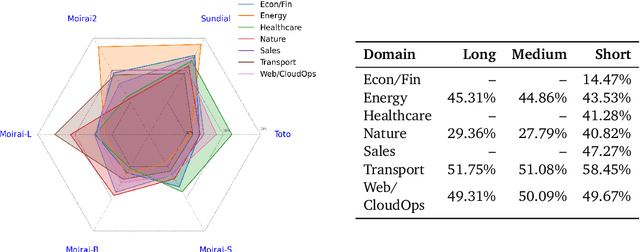
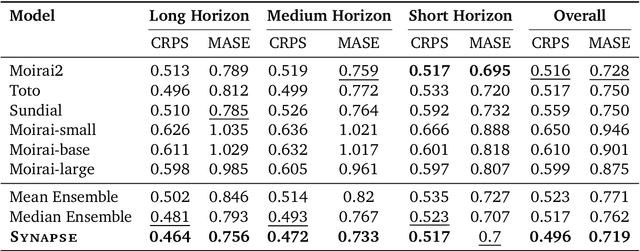
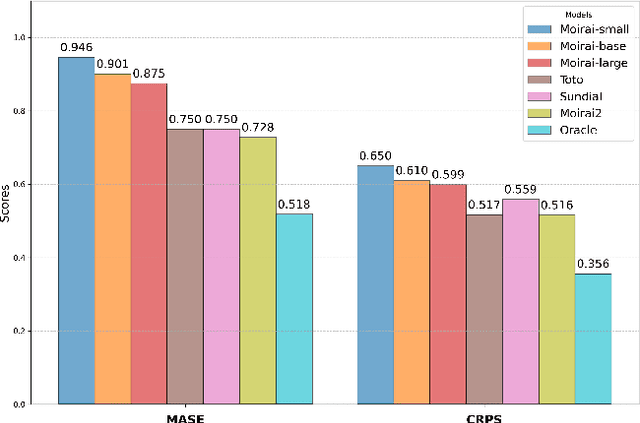

Pre-trained Time Series Foundational Models (TSFMs) represent a significant advance, capable of forecasting diverse time series with complex characteristics, including varied seasonalities, trends, and long-range dependencies. Despite their primary goal of universal time series forecasting, their efficacy is far from uniform; divergent training protocols and data sources cause individual TSFMs to exhibit highly variable performance across different forecasting tasks, domains, and horizons. Leveraging this complementary expertise by arbitrating existing TSFM outputs presents a compelling strategy, yet this remains a largely unexplored area of research. In this paper, we conduct a thorough examination of how different TSFMs exhibit specialized performance profiles across various forecasting settings, and how we can effectively leverage this behavior in arbitration between different time series models. We specifically analyze how factors such as model selection and forecast horizon distribution can influence the efficacy of arbitration strategies. Based on this analysis, we propose Synapse, a novel arbitration framework for TSFMs. Synapse is designed to dynamically leverage a pool of TSFMs, assign and adjust predictive weights based on their relative, context-dependent performance, and construct a robust forecast distribution by adaptively sampling from the output quantiles of constituent models. Experimental results demonstrate that Synapse consistently outperforms other popular ensembling techniques as well as individual TSFMs, demonstrating Synapse's efficacy in time series forecasting.
In Prospect and Retrospect: Reflective Memory Management for Long-term Personalized Dialogue Agents
Mar 11, 2025Large Language Models (LLMs) have made significant progress in open-ended dialogue, yet their inability to retain and retrieve relevant information from long-term interactions limits their effectiveness in applications requiring sustained personalization. External memory mechanisms have been proposed to address this limitation, enabling LLMs to maintain conversational continuity. However, existing approaches struggle with two key challenges. First, rigid memory granularity fails to capture the natural semantic structure of conversations, leading to fragmented and incomplete representations. Second, fixed retrieval mechanisms cannot adapt to diverse dialogue contexts and user interaction patterns. In this work, we propose Reflective Memory Management (RMM), a novel mechanism for long-term dialogue agents, integrating forward- and backward-looking reflections: (1) Prospective Reflection, which dynamically summarizes interactions across granularities-utterances, turns, and sessions-into a personalized memory bank for effective future retrieval, and (2) Retrospective Reflection, which iteratively refines the retrieval in an online reinforcement learning (RL) manner based on LLMs' cited evidence. Experiments show that RMM demonstrates consistent improvement across various metrics and benchmarks. For example, RMM shows more than 10% accuracy improvement over the baseline without memory management on the LongMemEval dataset.
Magnet: Multi-turn Tool-use Data Synthesis and Distillation via Graph Translation
Mar 10, 2025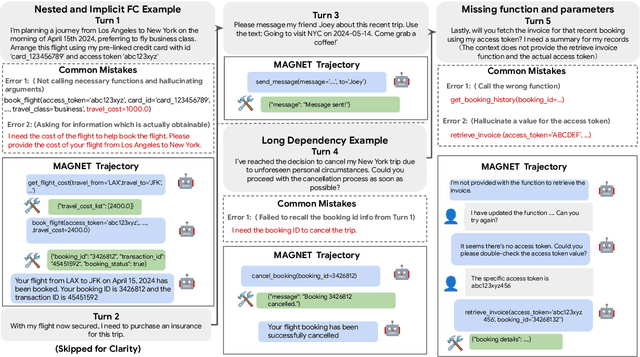
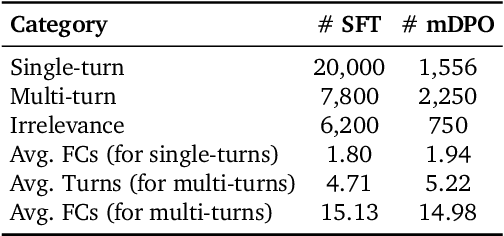
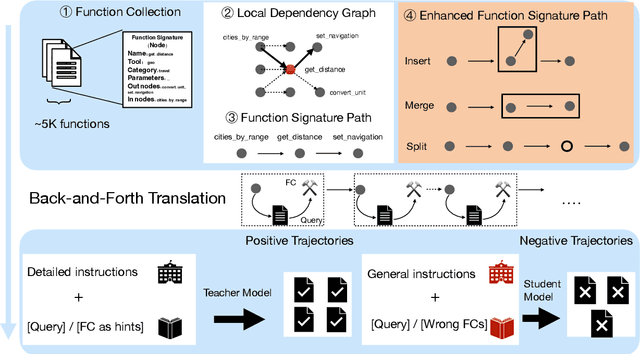

Large language models (LLMs) have exhibited the ability to effectively utilize external tools to address user queries. However, their performance may be limited in complex, multi-turn interactions involving users and multiple tools. To address this, we propose Magnet, a principled framework for synthesizing high-quality training trajectories to enhance the function calling capability of large language model agents in multi-turn conversations with humans. The framework is based on automatic and iterative translations from a function signature path to a sequence of queries and executable function calls. We model the complicated function interactions in multi-turn cases with graph and design novel node operations to build reliable signature paths. Motivated by context distillation, when guiding the generation of positive and negative trajectories using a teacher model, we provide reference function call sequences as positive hints in context and contrastive, incorrect function calls as negative hints. Experiments show that training with the positive trajectories with supervised fine-tuning and preference optimization against negative trajectories, our 14B model, Magnet-14B-mDPO, obtains 68.01 on BFCL-v3 and 73.30 on ToolQuery, surpassing the performance of the teacher model Gemini-1.5-pro-002 by a large margin in function calling.
Speculative Knowledge Distillation: Bridging the Teacher-Student Gap Through Interleaved Sampling
Oct 15, 2024


Recent advances in knowledge distillation (KD) have enabled smaller student models to approach the performance of larger teacher models. However, popular methods such as supervised KD and on-policy KD, are adversely impacted by the knowledge gaps between teacher-student in practical scenarios. Supervised KD suffers from a distribution mismatch between training with a static dataset and inference over final student-generated outputs. Conversely, on-policy KD, which uses student-generated samples for training, can suffer from low-quality training examples with which teacher models are not familiar, resulting in inaccurate teacher feedback. To address these limitations, we introduce Speculative Knowledge Distillation (SKD), a novel approach that leverages cooperation between student and teacher models to generate high-quality training data on-the-fly while aligning with the student's inference-time distribution. In SKD, the student proposes tokens, and the teacher replaces poorly ranked ones based on its own distribution, transferring high-quality knowledge adaptively. We evaluate SKD on various text generation tasks, including translation, summarization, math, and instruction following, and show that SKD consistently outperforms existing KD methods across different domains, data sizes, and model initialization strategies.
Found in the Middle: Calibrating Positional Attention Bias Improves Long Context Utilization
Jun 23, 2024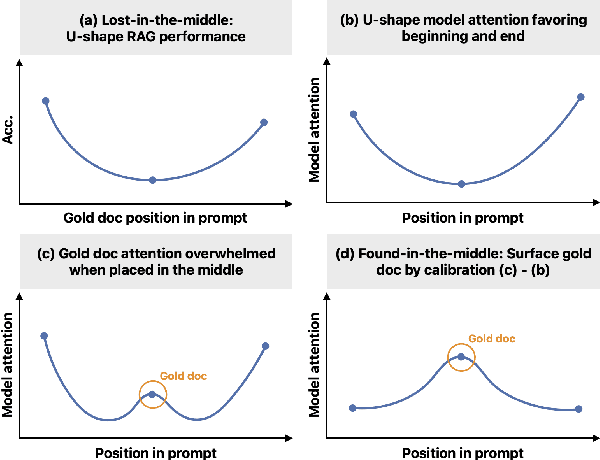

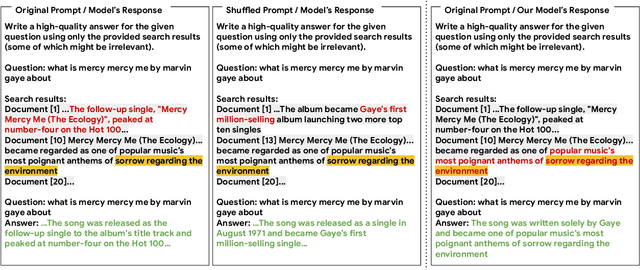

Large language models (LLMs), even when specifically trained to process long input contexts, struggle to capture relevant information located in the middle of their input. This phenomenon has been known as the lost-in-the-middle problem. In this work, we make three contributions. First, we set out to understand the factors that cause this phenomenon. In doing so, we establish a connection between lost-in-the-middle to LLMs' intrinsic attention bias: LLMs exhibit a U-shaped attention bias where the tokens at the beginning and at the end of its input receive higher attention, regardless of their relevance. Second, we mitigate this positional bias through a calibration mechanism, found-in-the-middle, that allows the model to attend to contexts faithfully according to their relevance, even though when they are in the middle. Third, we show found-in-the-middle not only achieves better performance in locating relevant information within a long context, but also eventually leads to improved retrieval-augmented generation (RAG) performance across various tasks, outperforming existing methods by up to 15 percentage points. These findings open up future directions in understanding LLM attention bias and its potential consequences.